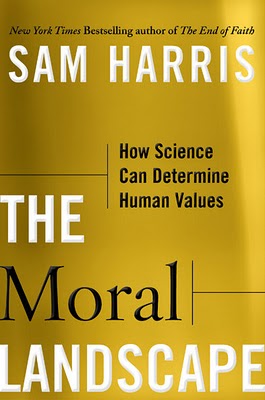
 Sam Harris’s first book, The End of Faith, ignited a worldwide debate about the validity of religion. In the aftermath, Harris discovered that most people—from religious fundamentalists to nonbelieving scientists—agree on one point: science has nothing to say on the subject of human values. Indeed, our failure to address questions of meaning and morality through science has now become the most common justification for religious faith. It is also the primary reason why so many secularists and religious moderates feel obligated to "respect" the hardened superstitions of their more devout neighbors.In this explosive new book, Sam Harris tears down the wall between scientific facts and human values, arguing that most people are simply mistaken about the relationship between morality and the rest of human knowledge. Harris urges us to think about morality in terms of human and animal well-being, viewing the experiences of conscious creatures as peaks and valleys on a "moral landscape." Because there are definite facts to be known about where we fall on this landscape, Harris foresees a time when science will no longer limit itself to merely describing what people do in the name of "morality"; in principle, science should be able to tell us what we ought to do to live the best lives possible.
Showing posts with label Anti-Christian book. Show all posts
Showing posts with label Anti-Christian book. Show all posts
The Moral Landscape: How Science Can Determine Human Values BY Sam Harris
Sam Harris’s first book, The End of Faith, ignited a worldwide debate about the validity of religion. In the aftermath, Harris discovered that most people—from religious fundamentalists to nonbelieving scientists—agree on one point: science has nothing to say on the subject of human values. Indeed, our failure to address questions of meaning and morality through science has now become the most common justification for religious faith. It is also the primary reason why so many secularists and religious moderates feel obligated to "respect" the hardened superstitions of their more devout neighbors.In this explosive new book, Sam Harris tears down the wall between scientific facts and human values, arguing that most people are simply mistaken about the relationship between morality and the rest of human knowledge. Harris urges us to think about morality in terms of human and animal well-being, viewing the experiences of conscious creatures as peaks and valleys on a "moral landscape." Because there are definite facts to be known about where we fall on this landscape, Harris foresees a time when science will no longer limit itself to merely describing what people do in the name of "morality"; in principle, science should be able to tell us what we ought to do to live the best lives possible.
101 Contradictions in the Bible

Filled with Fascinating Quotes from the Most Famous Book in the World. Contradictions in the Bible Teaches us that even Perfection still needs work. Discover what the Bible says but we do not notice, understand in a new dimension what the Holy Book is Really telling you. Make up your own mind and decide. Are You a leader or a Follower?
To download this for free click here
Biblical Nonsense: A Review of the Bible for Doubting Christians
 Biblical Nonsense is a broad look at the tremendous problem of associating divinity with the world’s most popular book. This part-philosophical, part-scientific overview explores the Bible’s divine treachery, scientific mistakes, historical errors, false prophecies, and comical absurdities.Biblical Nonsense also expands beyond these standard reasons for skepticism by tackling the rationale behind the emergence and perpetuation of Christianity, psychological and sociocultural reasons that drive Christians to cling to their beliefs, and illogical methods of argumentation invoked in the defense of the Bible.
Atheism - The Case Against God
 This book is a hard hitting attack against belief in the Christian God as well as all other supernatural beings (called 'gods' in the book). Intended primarily for laymen and consequently relatively free from technical philosophical argument and jargon, this book might well be used in a beginning course in the philosophy of religion as a fair representation of contemporary atheistic thought. Students would, I believe, find it more provocative and challenging, than some other treatment that may be technically more sophisticated. The author's direct and forceful way of making his points has great appeal; clearly, it is a book written with deep intellectual passion.
However, there are some limitations to the book as an introduction to atheism and teachers of philosophy might wish to supplement it with other works. First, Smith's critical treatment of the standard arguments for the existence of God is incomplete. Variants of the cosmological and technological arguments are critically evaluated, but the ontological
Why I am Not a Christian
 Why I Am Not a Christian is an essay by the British philosopher Bertrand Russell hailed by The Independent as "devastating in its use of cold logic",[1] and listed in the New York Public Library's list of the most influential books of the 20th century
Russell begins by defining what he means by the term Christian and sets out to explain why he does not "believe in God and in immortality" and why he does not "think that Christ was the best and wisest of men", the two things he identifies as "essential to anybody calling himself a Christian". He considers a number of logical arguments for the existence of God, including the cosmological argument, the natural-law argument, the teleological argument and moral arguments following what he describes as "the intellectual descent that the Theists have made in their argumentations". He also goes into specifics about Christian theology, alleging defects in Jesus's teaching and his moralcharacter, in particular because Jesus believed in hell and everlasting punishment. He argues ad absurdum against the "argument from design", and favors Darwin's theories:
In Defense of Atheism :The Case against Christianity, Judaism and Islam
 This book was an enjoyable read, but in the end Onfray did not prove his thesis. After the preface, which fished me in, the first third of the book was a bit of a slog. I have to admit after he used the word ontological three times in the first few pages, I had to get my dictionary to look it up.
The preface describes a trip to the middle east where he visited with desert nomads – ignorant people whose way of life, and thinking, had not changed in thousands of years. These people were the very model of the founders of monotheism. And, why would their insights into the world have any relevance to today. The short answer … it wouldn’t.
The second half of the book makes a damning case against the big three monotheisms. They are big fat targets that are incredibly easy to ridicule. But I don’t think he has made a convincing case for atheism. More on that later.
He spends a great number of pages lamenting the fact that atheism is a negative term “a” - “theism” ie. against or not theistic. The theisms all have positive names: the big three names in the subtitle, plus an endless list of nouns and proper nouns: deist, pantheist, monotheist, polytheist, animists, Catholics, Protestants, Lutherans, Calvinists, Shiite, Sunni, etc. He claims that language lacks a noun that describes our beliefs with a positive construction. He doesn’t deal with what I think are positive and suitable descriptors: realist, humanist, scientist, observationalist. But I will grant him that we do not commonly label people such as myself with a name other than “atheist".
God's Problem-How the Bible Fails to Answer Our Most Important Question— Why We Suffer
 This book deals with a matter that is very important to me, not just professionally but also personally. I have written it for a broad audience of regular readers, not for a narrow audience of specialists
(who might, I suppose, be considered irregular readers). In view of the intended audience, I have kept endnotes and references to a sparse minimum. Anyone interested in further, in-depth scholarship
can easily find it by looking around a bit. Two excellent places to start are James L. Crenshaw’s Defending God: Biblical Responses to the Problem of Evil (New York: Oxford University Press, 2005),
and Antti Laato and Johannes C. de Moor’s Theodicy in the World of the Bible (Leiden: E. J. Brill, 2003). Both books are fully documented, and the former provides an extensive bibliography. I have focused on the biblical “solutions” to the problem of suffering that strike me as the most important. Since the so-called classical view dominates the Hebrew Bible and the apocalyptic view dominates the New Testament,
Subscribe to:
Posts (Atom)