Showing posts with label Atheism. Show all posts

Living Without God:New Directions for Atheis Agnostics, Secularists, and Undecided - BY Ronald Aronson


Books which explicitly and directly critique religion from a secular atheist perspective have been incredibly popular in recent years, but while critique of religion may be a necessary starting point it isn't the ending point — or even very much of the journey. Critique of religion tells us about what isn't reasonable to believe or do, but more is needed to understand what is reasonable to believe or do.
Thus the books critiquing religion have created space that needs to be filled by different sorts books and Ronald Aronson make his contribution with Living Without God: New Directions for Atheists, Agnostics, Secularists, and the Undecided. There is hardly anything here that would qualify as a criticism of religion; instead of describing where religions get things wrong Aronson offers ideas about where secular atheists should go instead to get things right.
There are a lot of positives and negatives in Aronson's effort, depending on how you look at it. Basically, the details are all generally good but they are framed and presented in a way that isn't so good and which takes away from the overall effort. The central problem as I see it is that Aronson seems to want to offer an overall philosophy or set of principles for nonbelievers. His motive is good and he's justifiably concerned with the lack of confidence nonbelievers have, at least relative to believers.

Atheism and Philosophy - Kai Nielsen


The indeterminacy of the modern concept of God has made the distinction between belief and unbelief increasingly problematic. Both the complexity of the religious response and the variety of skeptical philosophies preclude simplistic definitions of what constitutes belief in God. Making the discussion even more difficult are assertions by fundamentalists who dismiss the philosophical perplexities of religious claims as unreal pseudo-problems. Atheism & Philosophy is a detailed study of these and other issues vital to our understanding of atheism, agnosticism, and religious belief. Philosopher Kai Nielsen develops a coherent and integrated approach to the discussion of what it means to be an atheist. In chapters such as "How is Atheism to be Characterized?", "Does God Exist?: Reflections on Disbelief," "Agnosticism," "Religion and Commitment," and "The Primacy of Philosophical Theology," Nielsen defends atheism in a way that answers to contemporary concerns.

Infidel by Ayaan Hirsi Ali


Ayaan Hirsi Ali was born in Somalia, raised Muslim and came to the Netherlands as a refugee due to an unwanted marriage. After earning her collage degree in political science, she worked for a labour party. Reading The Atheist Manifesto (Atheistisch Manifest) by philosopher Herman Philipse and the Quran pushed her to renounce Islam and become atheist. Now she is a controversial political figure who is against Islamic culture.

This is her astonishing story.


Infidel is an overwhelming book to grasp. Why? Well, because so much has happened so far in Ms. Ali's life. In addition, she takes you into mental spaces where you've never been before and this takes more than a little stretching. 
Here's the bottom line: In the course of her first three and a half decades of life, Ms. Ali moved from being born into a medieval-type lifestyle in Africa and Arabia based on Islam to becoming a prominent social critic of Islam in Europe and the United States who is well listened to wherever she goes. At the same time, she required enormous personal security to keep her alive as those she criticized sought to silence her. 

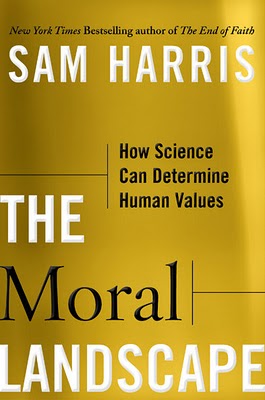
The Moral Landscape: How Science Can Determine Human Values BY Sam Harris

Sam Harris’s first book, The End of Faith, ignited a worldwide debate about the validity of religion. In the aftermath, Harris discovered that most people—from religious fundamentalists to nonbelieving scientists—agree on one point: science has nothing to say on the subject of human values. Indeed, our failure to address questions of meaning and morality through science has now become the most common justification for religious faith. It is also the primary reason why so many secularists and religious moderates feel obligated to "respect" the hardened superstitions of their more devout neighbors.In this explosive new book, Sam Harris tears down the wall between scientific facts and human values, arguing that most people are simply mistaken about the relationship between morality and the rest of human knowledge. Harris urges us to think about morality in terms of human and animal well-being, viewing the experiences of conscious creatures as peaks and valleys on a "moral landscape." Because there are definite facts to be known about where we fall on this landscape, Harris foresees a time when science will no longer limit itself to merely describing what people do in the name of "morality"; in principle, science should be able to tell us what we ought to do to live the best lives possible.

A Guide for the Godless

This book aims to apply recent thinking in philosophy to the age-old problem of the meaning of life, and to do so in a way that is useful to atheists, agnostics, and humanists. The book reorients the search for meaning away from a search for purpose and toward a search for what truly matters, and criticizes our society's prevailing theory of value, the preference satisfaction theory of the economists. It next argues that emotions are our best guides to what matters in life, and shows how emotional judgments about what matters can be true. Finally it discusses how a meaningful life can be lived, describes the role of justice, freedom, identity, and culture in its construction, and compares the meaningful with the happy life.

Losing My Religion by William Lobdell


From the New York Times:
"There are many great books about finding God. But there are far fewer books, great or otherwise, about finding and then losing God. So 'Losing My Religion,' by William Lobdell, a former religion writer for The Los Angeles Times, feels powerfully fresh ... While Lobdell never entirely rejects belief in the supernatural, his humane, even-tempered book does more to advance the cause of irreligion than the bilious atheist tracts by Christopher Hitchens and others that have become so common. And Lobdell’s self-deprecating memoir is far more fun to read ...
From Christopher Hitchens, author of “God Is Not Great“:
“William Lobdell really and truly wanted to believe. When he came to realize that wanting and believing are two sides of the same coin, he decided to take the risk of basing morality on the modest of human reason and solidarity instead of on the self-defeating arrogance of faith."

The Battle for God- By: KAREN ARMSTRONG

About 40 years ago popular opinion assumed that religion would become a
weaker force and people would certainly become less zealous as the
world became more modern and morals more relaxed. But the opposite has
proven true, according to theologian and author Karen Armstrong, who
documents how fundamentalism has taken root and grown in many of the
world's major religions, such as Christianity, Islam, and Judaism. Even
Buddhism, Sikhism, Hinduism, and Confucianism have developed
fundamentalist factions. Reacting to a technologically driven world
with liberal Western values, fundamentalists have not only increased in
numbers, they have become more desperate, claims Armstrong, who points
to the Oklahoma City bombing, violent anti-abortion crusades, and the
assassination of President Yitzak Rabin as evidence of dangerous
extremes.

The path to reason

Smith, a business analyst at a computer software firm who was once a conservative Christian, seeks to eliminate misconceptions about atheism and skepticism by examining faith and reason, the two means by which we evaluate our world. Writing for those who are confused by media representations and culture wars about philosophy and religion, Smith explains his personal path to atheism and skepticism as he describes the collision of faith and reason, the application of reason to such ideas as the soul, God, and meaning, critical thinking, including its fallacies, and specific precepts of skepticism. He then explains Christianity as he perceives it, analyzing such ideas as heaven and hell, the ten commandments, sex and violence, Jesus in the books of Matthew and John, the end times, prophecy and religious history, and the facts of life of a committed atheist.

ATHEISM AS A POSITIVE SOCIAL FORCE

The common definition of an atheist is pretty perfunctory: “one who denies
or disbelieves in the existence of God.” But atheism has its own value as a way of
life; it is not only significant as a philosophical position held in opposition to
religion. Without a doubt the most important concern of atheism is: What
would atheism propose to replace the existence of God? The simple, usual
definition is actually of very little use.
The majority of this work will be an attempt to set forth the major lines of
philosophical argument that support the position of atheism in a world which
still believes, and lives as if, God exists and directs the workings of the world. In
the course of this presentation it will also be necessary to set forth the major
philosophical arguments of those who rely upon religion as the support of their
belief in the existence of God. As the two counter positions are presented, it is

Arguing for Atheism

 As in so many atheistic books, Le Poidevin, a senior lecturer in philosophy at the University of Leeds, does not so much argue for atheism as that he argues against theism. Atheism is still often taken to be the opposite of theism, simply its denial. That is, atheism is taken to deny the existence of a god, especially a god that is supposed to be the creator of all things and to be omniscient, omnipotent, and perfectly good. Richard Swinburne, who assumes the existence of such a god, also speaks about god as a "person without a body (i.e. a spirit) who is eternal". Some atheists experience such a definition of the word "god" as implying a contradiction, whereas other atheists tend to believe that it is at least extremely unlikely that such a "person" exists.

GOD- A Debate between William Lane Craig and Walter Sinnott-Armstrong

The question of whether or not God exists has been debated vigorously
for millennia. It’s easy to see why so many people remain intensely
interested in this issue. According to traditional believers, human
existence finds its ultimate fulfillment only in relation to God.
Moreover, in the minds of many, eternal life hangs in the balance.
The effects of belief or disbelief in God can also be dramatic in this
world. Beliefs about God often influence positions on important and
controversial issues, such as sexual behavior, abortion, medical research
using stem cells, and, of course, prayer in public schools and
government support for religious schools and charities. Many decisions
in daily life—not just on Sunday—also depend on belief or disbelief
in God. Social action has often been motivated by belief in God.

101 Contradictions in the Bible


Filled with Fascinating Quotes from the Most Famous Book in the World. Contradictions in the Bible Teaches us that even Perfection still needs work. Discover what the Bible says but we do not notice, understand in a new dimension what the Holy Book is Really telling you. Make up your own mind and decide. Are You a leader or a Follower?


To download this for free click here

The Non-Existence of God

Is it possible to prove or disprove God’s existence?
Arguments for the existence of God have taken many different forms over
the centuries: the ontological, cosmological and teleological arguments;
arguments which invoke miracles, religious experience and morality; and
prudential arguments such as Pascal’s Wager. On the other hand are the
arguments against theistic belief: the traditional problem of evil; the logical
tensions between divine attributes such as omnipotence, omniscience and
eternity; and arguments from the scale of the universe.
In The Non-existence of God, Nicholas Everitt introduces and critically
assesses these arguments and examines the role that reason and knowledge
play in the debate over God’s existence. He draws on recent scientific
disputes over neo-Darwinism, the implications of ‘big bang’ cosmology, and

How to Be a Good Atheist

The title of Nick Harding’s book How to Be a Good Atheist, could mean morally good or effective. What is offered covers what ‘atheism’ means, a brief history of it, a justification, and an attack on religion. It is a short (160 pages) addition to the current spate of anti-religious books by Dawkins, Dennett, Hitchens, etc. It is very clear and readable, though there are some stylistic and grammatical slips.
He seems to agree with the view of some writers, that there are five subsets of atheism: dogmatic, sceptical, critical, philosophical and speculative. I would rather see a spectrum, ranging from mere absence of belief in God or gods, to either a denial of their existence, or the view that since there is neither evidence nor logical argument in favour, and rather good reasons against, a negative result is the only tenable conclusion. There is a chapter on “What is wrong with religion?” – essentially, that it relies on faith – although Harding points out that some religions have no gods. His history of atheism is clear if necessarily very condensed. There is a spirited defence of atheism against the usual silly attacks, e.g. it is just another faith, lots of bad people like Hitler have been atheists (he wasn’t, and in any case it is irrelevant), atheists cannot be moral, if we lose religion we lose all our finer qualities, love, art, music, etc., we all “really” believe in God but atheists won’t admit it, and so on.

The End of Faith


This is most definitely a book you’ll either love or hate, because whether or not you’ll end up agreeing with Harris you’ll still be moved by his words. For good or bad.

The End of Faith is quite likely the most brutal and in-your-face criticism of religious faith I’ve ever read, and one thing is for sure: Harris is VERY convinced that the monotheistic faiths and their followers are our version of Mordor and its evil creatures determined to ruin the world as we know it. More or less every single page of the book contains one or more sneers (some of them quite funny, too) aimed at the insanity in believing ancient scriptures and ideas that cannot be proven empirically nor discussed rationally. In Harris’ universe, this world of ours will face utter ruin any day now, and the religions – especially Christianity, Judaism, and Islam – are all to blame.

Breaking the Spell - Religion as a Natural Phenomenon


If nowhere else, the dead live on in our brain cells, not just as memories but as programs--computerlike models compiled over the years capturing how the dearly departed behaved when they were alive. These simulations can be remarkably faithful. In even the craziest dreams the people we know may remain eerily in character, acting as we would expect them to in the real world. Even after the simulation outlasts the simulated, we continue to sense the strong presence of a living being. Sitting beside a gravestone, we might speak and think for a moment that we hear a reply.
In the 21st century, cybernetic metaphors provide a rational grip on what prehistoric people had every reason to think of as ghosts, voices of the dead. And that may have been the beginning of religion. If the deceased was a father or a village elder, it would have been natural to ask for advice--which way to go to find wateror the best trails for a hunt.

God Wants You Dead

This book is about the past, present, and future evolution of human ideas. Its primary emphasis is on parasitic collectivist ideologies. It examines where such ideas come from, how they harm us, and how we can remove them from our own minds and from the culture around us. Finally, it tells us the amazing things that will become possible for humanity when they are gone. Not only religions, but also nation states, racial groups, corporations and other collectives are targeted for observation and criticism.
This book will probably offend you, if you hold any icons to be sacred or are a
believer in any ideology that encourages group loyalty and action. When you get
to a part criticizing your favorite ideology, please just try to remember that we are
actually trying to be helpful.

Atheism - The Case Against God


This book is a hard hitting attack against belief in the Christian God as well as all other supernatural beings (called 'gods' in the book). Intended primarily for laymen and consequently relatively free from technical philosophical argument and jargon, this book might well be used in a beginning course in the philosophy of religion as a fair representation of contemporary atheistic thought. Students would, I believe, find it more provocative and challenging, than some other treatment that may be technically more sophisticated. The author's direct and forceful way of making his points has great appeal; clearly, it is a book written with deep intellectual passion.
However, there are some limitations to the book as an introduction to atheism and teachers of philosophy might wish to supplement it with other works. First, Smith's critical treatment of the standard arguments for the existence of God is incomplete. Variants of the cosmological and technological arguments are critically evaluated, but the ontological

Superstition in All Ages


SUPERSTITION IN ALL AGES: A DYING CONFESSION
BY JEAN MESLIER
A Roman Catholic Priest, who at his death left as his “Last Will and Testament” this now famous manuscript as contained herein, entitled COMMON SENSE


This atheistic book was a work of by Baron d'Holbach's as but it was written under the name of Jean Meslier. It was originally published in French in 1772. Due to the severe restrictions on the press in the 18th century, d'Holbach published most of his work under the names of famous dead people. This book also includes a thirty-nine page abstract of the testament of John Meslier written by Voltaire. 


WHEN we wish to examine in a cool, calm way the opinions of men, we are very much surprised to find that in those which we consider the most essential, nothing is more rare than to find them using common sense; that is to say, the portion of judgment sufficient to know the most simple truths, to reject the most striking absurdities, and to be shocked by palpable contradictions. We have an example of this in Theology, a science revered in all times, in all countries, by the greatest number of mortals; an object considered the most

The Cambridge Companion to Atheism

In The Cambridge Companion to Atheism, eighteen of the world’s
leading scholars present original essays on various aspects of
atheism: its history, both ancient and modern, defense, and implications.
The topic is examined in terms of its implications for a wide range
of disciplines, including philosophy, religion, feminism, postmodernism,
sociology, and psychology. In its defense, both classical
and contemporary theistic arguments are criticized, and the
argument from evil and impossibility arguments, along with a nonreligious
basis for morality, are defended. These essays give a broad
understanding of atheism and a lucid introduction to this controversial
topic.